

The muscles we see in the mirror and train in the gym are important, but the shoulder is the most mobile joint in the body, and that mobility comes at a cost. It relies on a small group of muscles to stay healthy and move well, but three of them are consistently undertrained: the lower trapezius, the serratus anterior, and the rotator cuff.
If you deal with nagging shoulder pain, pinching when you reach overhead, or a shoulder that never quite feels strong, there is a good chance one or more of these muscles is not doing its job.
Why These Muscles Get Neglected
There are a few reasons these muscles fall through the cracks:
They are hard to see, hard to feel, and get taken for granted. Nobody is flexing their serratus in the mirror.
Modern life works against them. Hours at a desk leave the shoulders rounded and the upper traps do all the work, while the lower traps and serratus sit dormant.
Typical workouts overload the big movers. Bench press, push-ups, and overhead presses are great, but they can reinforce the dominant muscles while the stabilizers lag behind.
They don't feel "hard" the way big lifts do. Stabilizer exercises use light loads and slow control, so they are easy to skip.
The result is a shoulder that lacks foundational support and functions through compensation and learned dysfunction. That mismatch is a common setup for impingement, tendon irritation, and recurring pain.
The Lower Trapezius
The lower trapezius pulls the shoulder blade down and back and helps rotate it upward as you lift your arm. When it is weak or lacks neuromuscular control, the upper trap tends to take over, which can mean neck tension, a shrugged posture, and less room for the rotator cuff tendons when you reach overhead. We need this muscle to do more so that the upper trap does less.
Exercise: Prone Y Raise
Lie face down on a bench or bed with your arms hanging toward the floor (or lie on the floor with arms overhead). With thumbs pointing to the ceiling, lift your arms into a "Y" shape, squeezing your shoulder blades down and toward your back pockets. Keep your neck relaxed and imagine using your shoulder blades to lift your arms up.
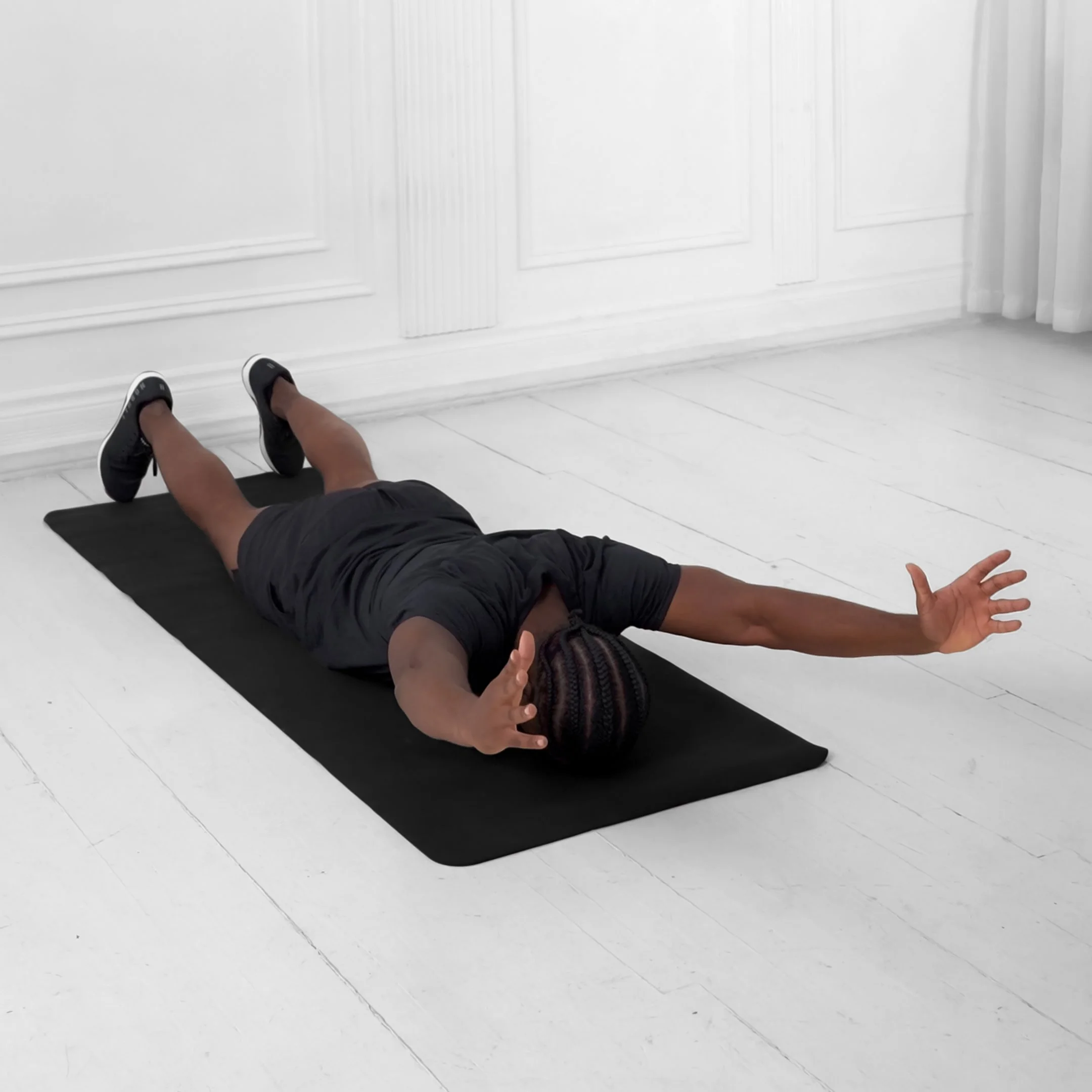
Dosage: 3 sets of 8-12 reps, holding 2-3 seconds at the top. No weight at first, progressing to 1-2 lbs when 3 sets of 12 feel easy. Perform 3 times per week.
The Serratus Anterior
The serratus anterior wraps around your rib cage and holds the shoulder blade flat against it. It also rotates the shoulder blade upward in tandem with your lower trap so your arm can travel overhead. When it is weak, the shoulder blade can lift off the rib cage (often called "winging"), the upper trap has to take over, and overhead motion becomes less efficient and more painful.
Exercise: Wall Slide
Stand facing a wall with your forearms on it, elbows bent at 90 degrees and shoulder-width apart, and palms facing each other. Press your forearms into the wall and push your upper back away from it, spreading your shoulder blades apart. Slide your forearms up the wall as far as you can without shrugging your shoulders. Then slowly return down to the starting position.
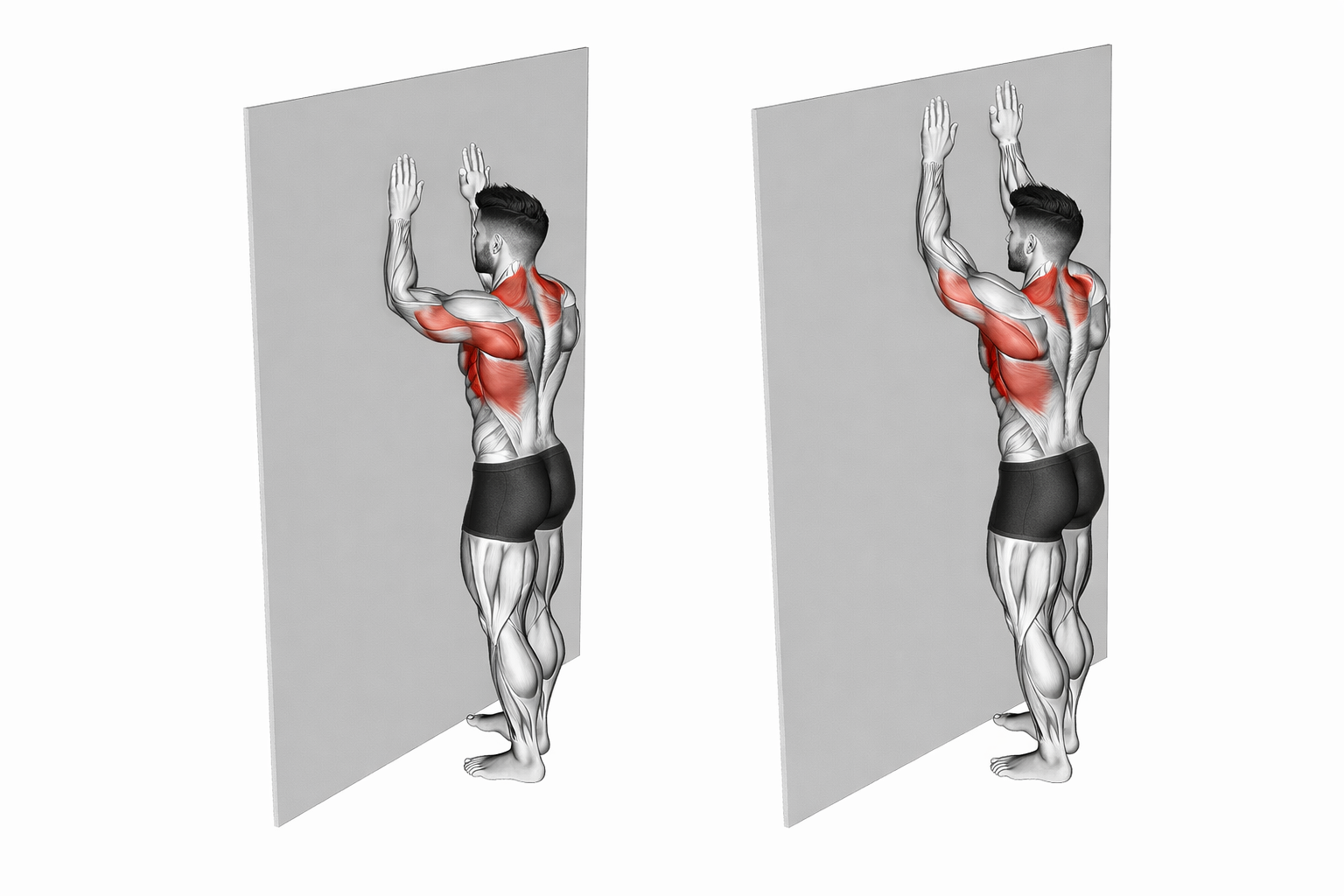
Dosage: 3 sets of 8-12 reps with a 3-second hold at the top of each rep. Perform 3 times per week. To progress, place a light resistance band around your wrists when 3 sets of 12 feel easy.
The Rotator Cuff
The rotator cuff is a group of four small muscles that both rotate the upper arm and keep the ball of the shoulder centered in its socket as you move. They fine-tune the position of the joint while the bigger muscles provide the power. A weak or fatigued cuff lets the joint drift, which can irritate tendons and the bursa and lead to pain with lifting, throwing, or reaching overhead.
Exercise: Side-Lying External Rotation
Lie on your side with a rolled towel between your elbow and ribs, elbow bent to 90 degrees, holding a light dumbbell with your thumb pointed up at the ceiling. Keeping your elbow tucked, rotate your forearm up toward the ceiling, then lower slowly over about 3 seconds.
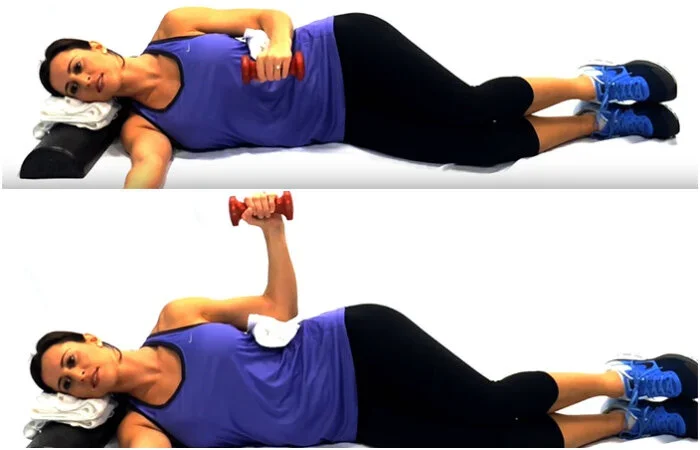
Dosage: 3 sets of 8-12 reps with a light weight; start with 1-3 lbs and progress when 3 sets of 12 feel easy. Perform 3 times per week.
Putting It Together
These three muscle groups work as a team. The lower trap and serratus control the shoulder blade, which is the platform your arm moves from, and the rotator cuff centers the joint within part of that platform. If any link is weak, others compensate, and that is often where pain begins.
A few tips for getting the most out of these exercises:
Go light and go slow. Quality beats load. If you cannot control the movement, the weight is too heavy.
Be consistent. Three short sessions a week will do more than one long session.
Expect muscle fatigue, not sharp pain. A mild burn is normal. Sharp or pinching pain is a sign to stop and ask for help.
When to Get Help
These exercises are a great starting point for general shoulder health, but they are not a substitute for an evaluation or ongoing treatment. If you have pain that lasts more than a couple of weeks, pain at night, notable weakness, or a shoulder that has been injured, a physical therapist can identify exactly which muscles to address and build a plan around you.